A global report on impact in journalism
A survey reveals that journalists strongly adhere to the idea that journalism should do more than inform. But they lack the tools to realize this vision.
Published: 3 August 2026
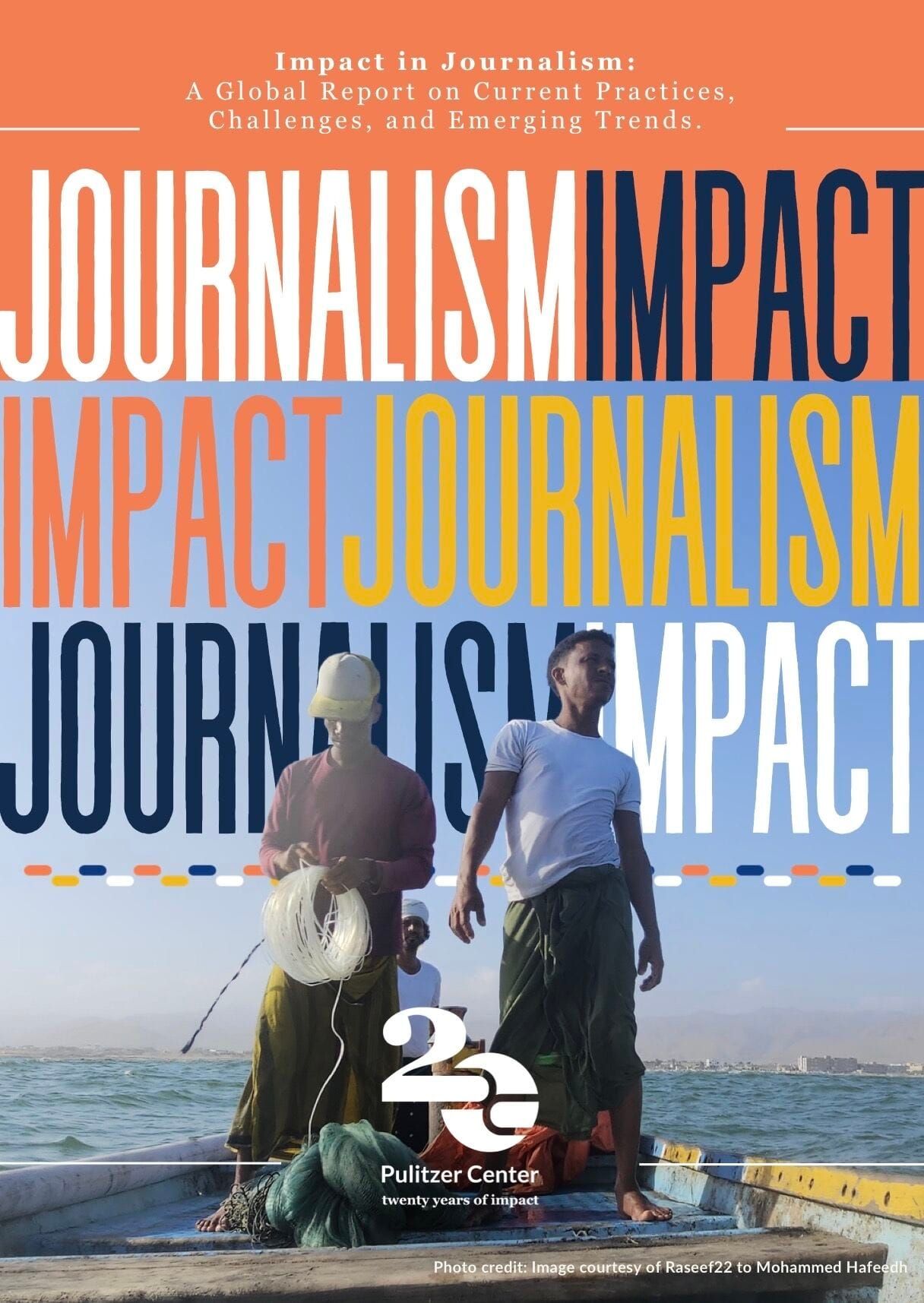
Early this year, 273 journalists across 51 countries took part in a global survey conducted by the Pulitzer Center to capture how they think about and measure the impact of their work. I helped design the survey and co-authored the report presenting its findings, which was recently launched at Festival Gabo, one of the largest gatherings in Latin American journalism.
In a nutshell, the responses reveal an industry in motion.
Across geographies, newsroom sizes, and professional roles, journalists are already embracing practices that extend beyond the traditional boundaries of news production. They also show strong receptiveness to the idea that journalism should so more than inform. The gap, therefore, is not in intent. It is in the conditions needed to make this approach effective.
Together with Flora Pereira, Pulitzer's Chief Impact Officer, I decided to include explicit distinctions among reach, engagement, and impact in the survey to support a more consistent interpretation of key concepts among respondents. The first two are more quantitative in nature: views, readership, comments, social media shares, time spent on articles and so on. In contrast, by impact we mean qualitative changes journalism may contribute to, such as increased awareness, narrative reframing, accountability, community organizing, behavioral shifts and policy reform.
The data allowed us to spot seven emerging trends, which I strongly encourage you to explore here. But I want to briefly highlight the ones that I find most illuminating.
- Impact remains weakly institutionalized. More than 70% of newsrooms report having having staff dedicated to reach and audience engagement. By contrast, just over half report having staff working on impact. Many small and mid-sized newsrooms (1-25 staff) report having no impact staff at all.
- Impact is not yet systematized. The use of tools or frameworks to plan for impact remains limited. Only 32% of staff and 27% of freelancers report having a framework when considering the impact potential of a story.
- The outcomes of much of journalists' work remain effectively invisible. Fewer than half of respondents report using impact indicators or impact trackers: 40.15% of newsroom staff and 33.82% of freelancers. Even among those who document impact, not everyone shares the results publicly. The proportion is especially low among freelancers, at 36%.
- Civil society partnerships, multi-stakeholder dialogues and engagement with schools and academia are not rare. Journalists already engage in impact-oriented practices, even if they do not formally describe these as impact work. Respondents associate this approach with greater audience trust (73.7% staff; 68% freelancers). However, it less clear to them how it might lead to more funding options (32.1% staff; 28.1% freelancers).
In other words, impact is showing up, but inconsistently:
In editorial workflows that consider impact at the beginning of a story but rarely ask what happened after it was published; in newsrooms that do not make time to document complex processes of change; or among freelance journalists who care deeply about what their reporting can make possible but rely largely on intuition rather than structured methodologies.
For me, this report contains two pieces of good news.
The first is that a significant part of the industry understands that journalism can not build its value solely around traditional metrics. A recent study by FT Strategies and WAN-IFRA reached a similar conclusion: trust is increasingly shaped through relational signals.
But, as the survey suggests, journalists and newsrooms need to devote more efforts to the tasks that can ensure reporting lives on in conversations, public debates, community connections, educational programs and long-term processes of change.
The second piece of good news is that the report reveals a clear opportunity for meaningful support. In fact, one of the reasons Flora asked us to embark on this project was to ensure that future assistance would be based on concrete information rather than assumptions.
The question that remains open for me is what the best approach should be.
Can a single impact design framework work for all in our industry? Should each newsroom and journalist build their own impact trackers and documentation systems? Should we adapt templates used in other fields, such as documentary filmmaking and the social sciences?
Several initiatives have already begun exploring these questions. Lindsay Green Barber's Impact Architects was the first organization I came across that inspired my news outlet's own impact measurement tool. Dr. Annya Schiffrin and her colleagues published an impact matrix for measuring journalism's impact. More recently, Eliz Mizon developed a prototype for an impact app that aims to guide organizations even in the planning stages of a story. She has been looking for newsrooms that want to test it.
At El Surti's Change CoLab, we are sharing our own set of tools with our partner outlets in South America. These tools help envision the transformative potential of a story, map the key actors that can drive change, and design the types of engagement most likely to lead to meaningful impact. But I am not entirely sure that the same tools would be always useful for large, legacy outlets in the region—let alone for news organizations in the Global North.
I'm fully in favor of building a baseline that can be shared across regions and avoiding the duplication of efforts. For me, that baseline consists of language, rituals and roles. I recently shared some of this thinking at the Impact Network's latest meetup.
Mattia Peretti, who co-hosted the meetup, did a great job of summarizing the main points in his newsletter (have you signed up for News Alchemists? It ranks among my top three media newsletters. I highly recommend it).
At the same time, I am mindful of how much context matters. For instance, what does impact practice look like for a newsroom or journalist in exile? Can change have the same signals under closed regimes as it does in open societies? These are some of the more difficult questions we need to ask before jumping into one-size-fits-all solutions.