A cross-border collaboration for change
A coalition of outlets in South America will test what happens when they collectively work for impact
Published: 13 May 2026
Hello! I’m really happy to be back here. I hope your curiosity about change-centric journalism is still intact. I’ve been quiet these past months, mostly for one reason.
In February, my outlet’s tenth birthday (!) was marked by a series of radical changes that my partners and I decided to make. In part, this was a response to the imminent application of a foreign agents styled law, of which we are considered a major target by legislators aligned with transnational far-right networks and the Trump administration. The government’s propaganda machinery has amplified these attacks.
None of this is surprising, unfortunately. Our fierce independence has long been a pain to local elites, and they will not hesitate to strike. But we will not back down. We are rolling out again, with the same independent spirit, some important evolutions in our overall strategy, and even bigger ambitions. Before sharing one major step we’re taking in this newsletter, here are three updates around change-centric journalism that stood out in recent months.
- I was thrilled to learn that El Bus TV from Venezuela — one of my all-time favorite outlets in Latin America — has started using the framework of change-centric journalism to explain how they work. This remarkable newsroom has managed to reach audiences and circumvent censorship by jumping onto buses to share the news out loud, or by posting stories in public squares for passersby to read. It’s a moving example of resilience, creativity, and public service. If you haven’t heard about them, please do yourself a favor.
- Salud con Lupa director Fabiola Torres says her outlet is becoming increasingly change-centric: “We want to build real connections with our audience, listen to affected communities, and open spaces for dialogue that can facilitate concrete changes.” Shortly after her team revealed how an algorithm wrongly excluded thousands of Peruvians living in extreme poverty from a pension program, the government introduced mechanisms for citizens to report these errors. “These types of changes remind us that journalism doesn’t stop at publication”, Fabiola says. Exactly.
- A unique report on how journalists and news organizations think about impact is also on its way. The Pulitzer Center tasked me with designing the survey that will inform this report. We sought answers and input from colleagues in every region of the world. Together with Chief of Impact Flora Pereira and her team, we hope to soon release fresh insights on what is already working, where the gaps lie, and what tensions and opportunities are emerging in our field.
The next step in the evolution of journalism collaborations?
During conversations about change-centric journalism, two interrelated questions have surfaced: how do we address issues that are transnational in nature? And can large-scale collaborations apply this approach effectively?
Some colleagues understandably assume that change-centric journalism works best at the local level, within a limited territory. The issue of scale, particularly in terms of scope, comes up often.
I’m not entirely convinced this is the case. Scale complicates the process, but the principles remain relevant. The same demands that exist for individual outlets also apply to broad partnerships: connecting with audiences that can act upon findings; convening experts and communities around shared concerns; experimenting with new forms of engagement; and measuring impact that do not appear in the form of numbers but in movements and shifts in narratives, cultures and systems.
At Perugia’s IJF this year, on a panel about the need to evolve collaborations, Marina Walker somewhat hinted at this:
Collaborations will be much more interdisciplinary in the coming years. Journalists, architects, lawyers, all together.
My partners and I have decided to test what a change-centric media collaboration could actually look like. Starting in July, El Surti will convene and lead a coalition of outlets across South America to explore how stories about the technological disruption in our region can drive tangible change. We’re calling it the Change CoLab.
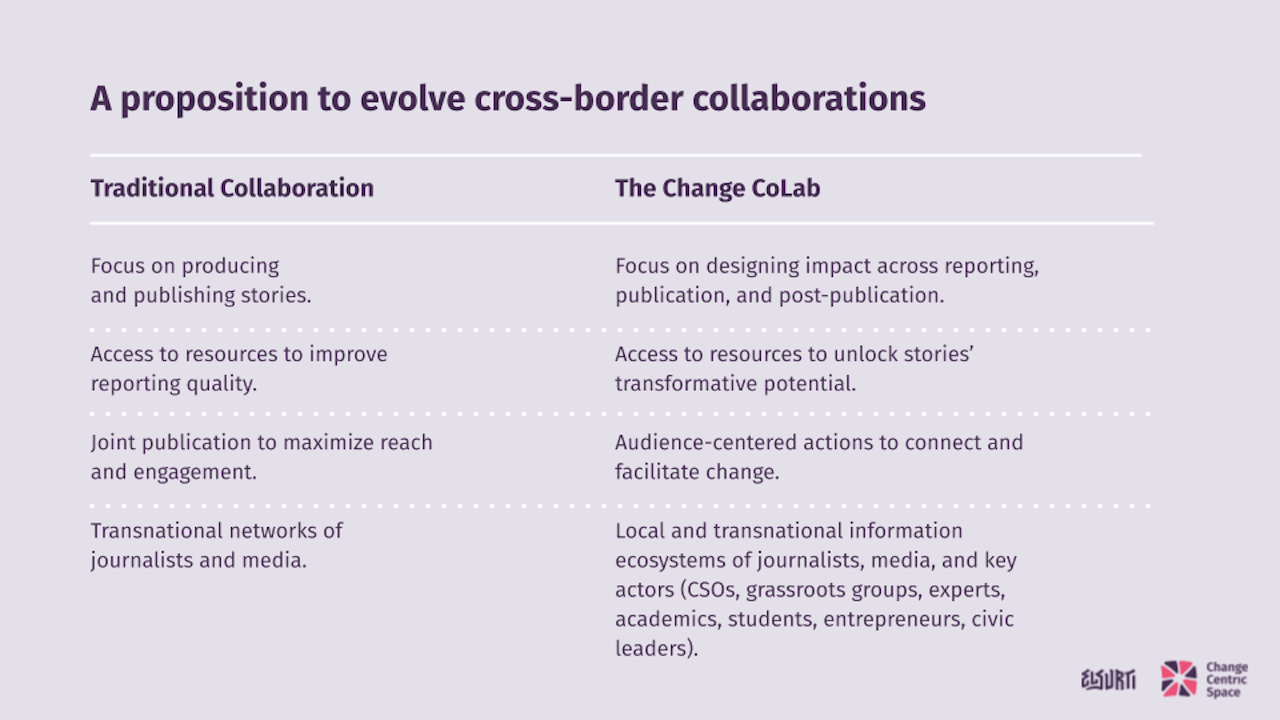
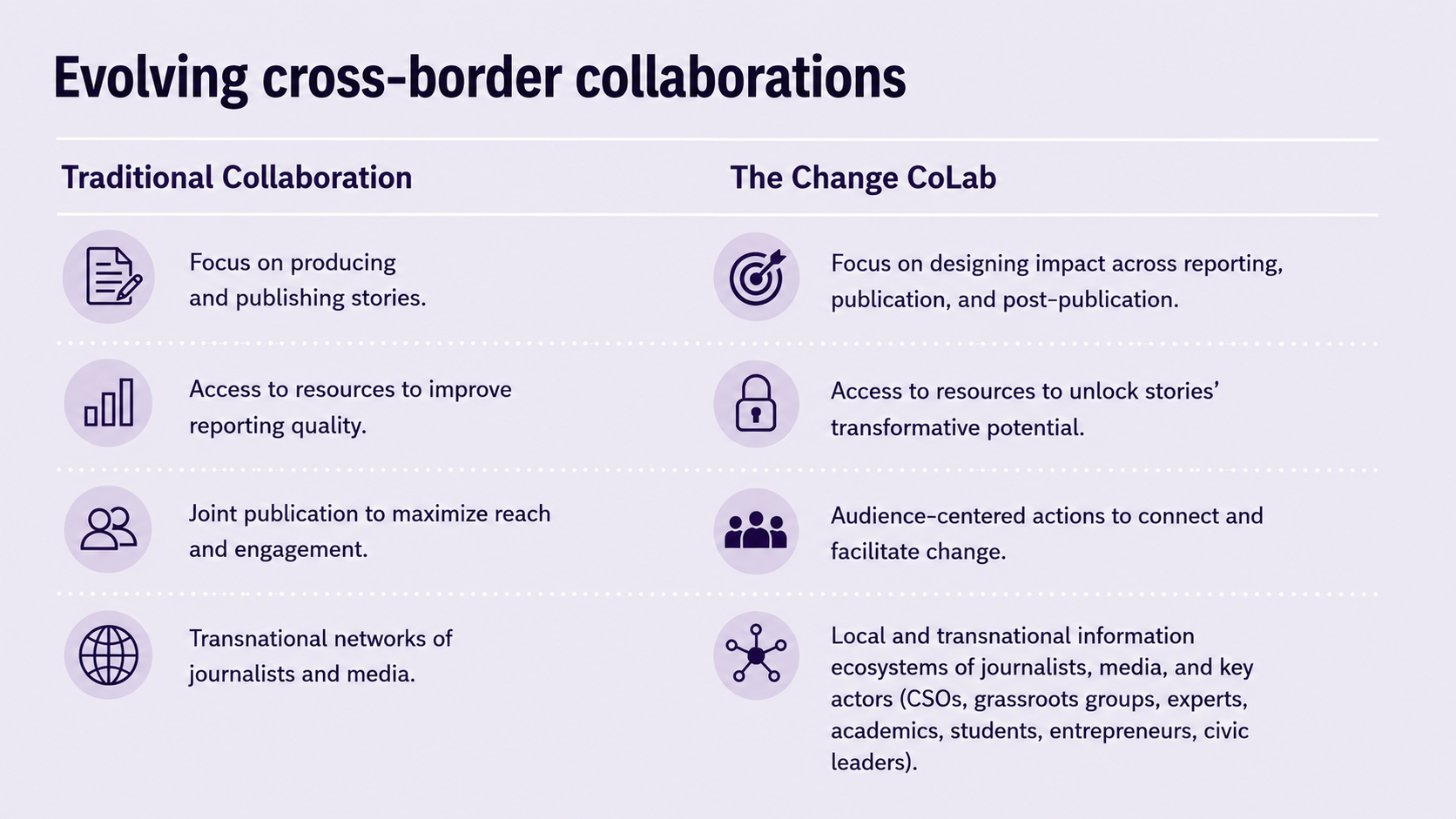
How will this differ from a traditional news collaboration? As I see it, here are some of the major distinctions:
To be clear, journalism collaborations have shown us their remarkable strength over the years. Together, outlets have had extraordinary capacity to uncover abuses that no single newsroom could expose alone. Some have led to investigations, convictions, and other substantial outcomes.
Yet I’ve also been part of very valuable collaborations whose stories, despite their importance, quickly disappeared into the endless stream of content. It is important to address this tension.
Here’s where the Change CoLab comes in. In short, while traditional collaborations mainly coordinate story production, through the Change CoLab we will explore how those stories can transform realities.
Over six months, the outlets will rally around one reported issue and collectively build strategies for impact. That means identifying stakeholders, experimenting with IRL engagement formats, convening affected communities, building partnerships, and exploring pathways for action across borders.
Our vision is that by the end of the collaboration, we will have connected with a wide range of actors in the region. Rather than ending up solely with a network of news outlets, we hope to foster a regional information ecosystem capable of responding to shared problems.
And as we move forward and as we always do with initiatives at El Surti, I’ll continue sharing the details, tensions, and lessons emerging from this process.
Do you know someone who will be interested in connecting with us or sponsoring our efforts? We are looking for more allies. Please pass on the message. They can write to me at jazmin@changecentric.space.